


 Customer rating 4.8/5!
Bimetal M42
Bimetal M42


Bimetal M42
Bimetal M42
- Custom-made to your exact length
- Made to order in our own workshop
- Friendly and professional advice
Couldn't load pickup availability
Applications


Configure Your Blade
4.8 out of 5 from 2,400+ reviews on Valued Shops
TPI Selection
TPI Selection
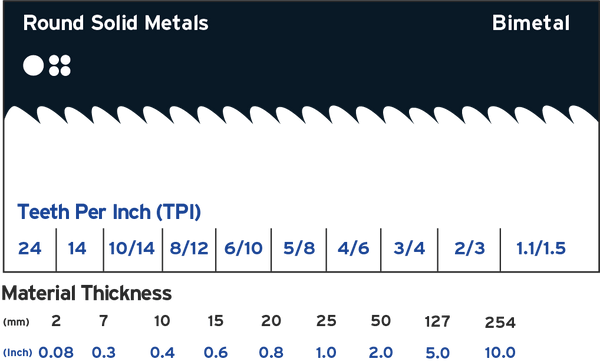
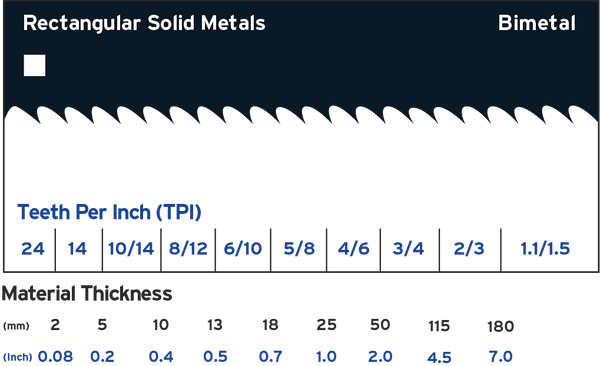
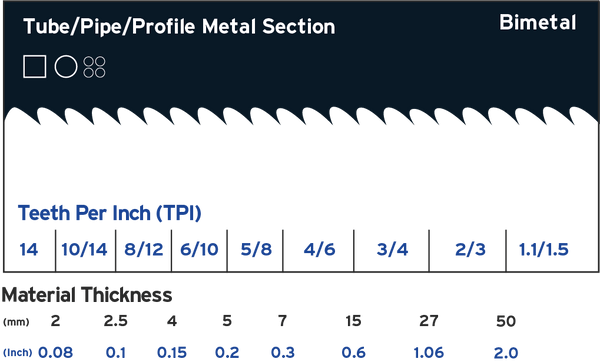
Product description
Product description
Bi-Metal M42 Bandsaw Blade for Metal
The Bi-Metal M42 bandsaw blade is an exceptionally robust and durable blade, perfectly suited for cutting both ferrous and non-ferrous metals. This bandsaw blade is crafted from two premium materials: a high-speed steel strip and a tough alloy spring steel backing. This combination ensures a low-maintenance blade with wear-resistant teeth, featuring an M42 cobalt tip for added durability. Additionally, the Bi-Metal M42 blade offers excellent resistance to high temperatures, making it ideal for intensive metalworking projects.
With a hardness of 67 HRC and an 8% cobalt tip, the Bi-Metal M42 bandsaw blade delivers unmatched longevity and precision, even in demanding sawing applications. These blades are available in various widths, ranging from 6 mm to 34 mm, making them compatible with a wide range of machines and uses.
Note: Blades with a thickness of 0.9 mm are recommended for machines with a wheel diameter of at least 2000 mm.
Bi-Metal M42 bandsaw blades are ideal for cutting:
- Ferrous metals
- Non-ferrous metals
Choose the Bi-Metal M42 bandsaw blade for efficient, wear-resistant, and precise cutting, even at high temperatures!
 Hey specialist, order €100 worth of products and your order ships for free.


Which metals can you cut with Bi-metal M42?
Steel and stainless steel, as well as non-ferrous metals such as aluminium and brass. The teeth are high-speed steel with an 8% cobalt tip on a spring steel back. That keeps them sharp for a long time and lets them handle the heat that builds up when cutting metal.
What does a tooth pitch like 10/14 TPI mean?
It is a variable pitch: the spacing between the teeth varies from 10 to 14 teeth per inch. A blade like this vibrates less and runs more smoothly through tube and profiles, where the wall thickness changes during the cut.
Which sizes can you order?
Any length from 500 to 12,000 mm, 6, 10, 13, 19, 27 or 34 mm wide. Teeth: 2/3, 3/4, 4/6, 4, 5/8, 6/10, 6, 8/12, 10/14 or 18 TPI. Blade thickness 0.65, 0.90 or 1.10 mm, depending on width and teeth. For profiles there is a 27 mm version with 4/6 TPI.
Not finding your question? See the frequently asked questions on our service page.

Check our latest blog & news
View More-

1400 mm bandsaw blade: which one fits your machine?
Need a 1400 mm bandsaw blade? Compare the sizes for the Scheppach HBS 20/30, Parkside PBS 350 A1 and more. Check the width and thickness too.
1400 mm bandsaw blade: which one fits your machine?
Need a 1400 mm bandsaw blade? Compare the sizes for the Scheppach HBS 20/30, Parkside PBS 350 A1 and more. Check the width and thickness too.
-

Which bandsaw blade for which material?
Which bandsaw blade for wood, plastic, metal, foam or food? For each material the right blade and the cutting speed in metres per minute.
Which bandsaw blade for which material?
Which bandsaw blade for wood, plastic, metal, foam or food? For each material the right blade and the cutting speed in metres per minute.
-

Choosing the right bandsaw blade: size, type and tooth pitch in fou...
Choosing the right bandsaw blade: length, width and thickness come from your machine, type and tooth pitch from the material. Here's how.
Choosing the right bandsaw blade: size, type and tooth pitch in fou...
Choosing the right bandsaw blade: length, width and thickness come from your machine, type and tooth pitch from the material. Here's how.


